Visit the wall
The Master Mariner Bar & Grill
3–5 Union Terrace, Marine Promenade
New Brighton, Wallasey CH45 2JT
 Captain Mike Lowe
Hear Mike · 0:00
Mike Lowe
Mike’s voice can’t play here yet, so his words follow along. Listen on YouTube
Mike’s voice is from the interview video made by Daffodil & Natural Selection Design, used with their kind permission. Watch it all
A story from the OpenAIR Gallery, New Brighton
In September 1952 he joined the Mersey ferries as the lad who kept the kettle on. He became the youngest captain ever to take the helm of a Mersey ferry, and spent close on thirty years on the river. This is his story, told as one long crossing: from first light at Woodside to the wall in New Brighton where he stands today.
With sound you hear the ship's bells and The Ballad of Captain Lowe, and Mike in his own words whenever you ask for him, from the interview video made by Daffodil & Natural Selection Design. The music steps aside while Mike talks, and the button at the top stops it. Scroll to cross. The telegraph in the corner moves you between log entries.




Log 0107:20Woodside, BirkenheadFlood tide
Michael John Lowe was born in Birkenhead and went to school there. His dad, Jack, was a seaman, and his uncle Henry rose to chief officer. Both sailed with Lamport and Holt, one of the great Liverpool shipping lines. The river was in the family before it was in Mike.
On Sundays his grandad, Fred Dunne, took him out. Coat on, the tram down to Woodside, across to Liverpool on the ferry, then up the river on the New Brighton boat, and all the way back again. Mike called it a complete circle.
I loved that. Never believed it'd be to do with being on the ferries when I grew up.
Mike Lowe
Log 0208:05Montgomery, mid WalesWartime
Evacuee
M. Lowe
Birkenhead Welshpool
Illustration
Then the war came. Mike was six or seven when he was put on a train with older children and sent to Wales. They got off at Welshpool. A bus took them on, and dropped him at a cottage in the middle of nowhere. On his own.
Mr and Mrs Davies kept the level crossing gates at Montgomery. The gates opened about twice a week. On Wednesdays the mobile shop came down the lane. The cottage had three rooms and no bed for an evacuee, so Mike slept under the settee. They weren't young, he says, but they did a good job. They were very nice.
One day, off school and ill, he heard a noise that wasn't a train.
As he went past, I waved to him, and he leaned back and he waved back. And what's interesting is that he was a German.
Mike Lowe
School was two miles away, down lanes and across fields. One morning they woke up to snow.
On the way back I had a game, walking in my own footsteps. Nothing else had been there, only my footsteps, all day.
Mike Lowe
Log 0309:10Pier Head, LiverpoolSeptember 1952
Back home he left school at fifteen and tried a job in a garage. It didn't suit. So he went over to Liverpool to see a pal, Frank Buttler. On the ferry back he asked one of the deckhands about work, heard they needed lads, and was sent round the corner to the marine superintendent's office.
He said, right, start tomorrow.
Mike Lowe
It was September 1952, and he was nineteen.
He was the lad. He kept the fire in the fo'c'sle nice and red, kept the kettle topped up for the captain and the mate, and sometimes cooked their breakfast. Then there were the ropes. When the spring rope man went for his break, the lad took the spring rope. Then he took over the stern rope.
Log 0410:20WoodsideEvery ten minutes
Mike joined at the right time. The captains and mates were all coming up to sixty, and the management realised there was nobody coming up behind them. They asked him to go for his mate's ticket.
I said yes, why not. I'll have a go.
Mike Lowe
The knowledge he needed wasn't in any book. You learned the river from the men who knew it, and most of them didn't want to tell him. Crews had stayed together for years. They went on holiday together and came back together. Nobody wanted a young lad coming up and disturbing that.
None of the captains really wanted to take me, because they were frightened of a young snotty-nosed kid coming up and disturbing them.
Mike Lowe
One man did. Captain Frank Cullen was big, powerful and very unpopular. Everybody did exactly what they were told. Nobody wanted to sail with him. Mike did, and it worked.
He turned out a great man to me.
Mike Lowe, on Captain Frank Cullen
He had a line for his new mate, too. "It's about time you learned to steer, Mr Mate."
Log 0511:40Cammell Laird, BirkenheadSea trials
In 1961 Cammell Laird began a new ferry for Birkenhead. Mike and his childhood friend Teddy Rodden went to the yard again and again to watch her take shape. She was the Overchurch, launched in November 1961. She was the first of the fleet to be welded all over instead of riveted, and the last boat built for the Birkenhead ferries.
Mike hadn't long been made mate. He and his skipper took her out into the bay for her trials, with the yard's engineers timing every run over the measured mile. His own doctor, who was also the yard's doctor, heard he was going and came along. "He was tickled pink."
They tell you what courses they want you on, and for so long, and they time you. It's simple. It was good, actually. And the weather was all right.
Mike Lowe
On her first trip over to Liverpool, the paper photographed Mike, the mate, with his daughter Christine, aged three, saying hello over the ship’s radio telephone.
The same year, aged 28, Mike was made master: the youngest the Birkenhead ferries had ever had. Five years on, the Liverpool Echo found him at work.
As he scans the Mersey from the bridge of the Overchurch, he knows he is doing the job he wanted to do since he was a youngster.
Liverpool Echo, 2 June 1967
Log 0612:40Off New Brighton pier1906 to now
Follow one name on the Mersey and you follow a century of the river. It runs from the Wallasey ferries, through a raid on the Belgian coast, to Mike's own sea trials and the new ferry on the river this autumn.
Built on the Tyne for the Wallasey ferries.
On Thursday 1 October 2026 Mike was back on the river, aboard the new Royal Daffodil on one of her showcase cruises from the Pier Head.
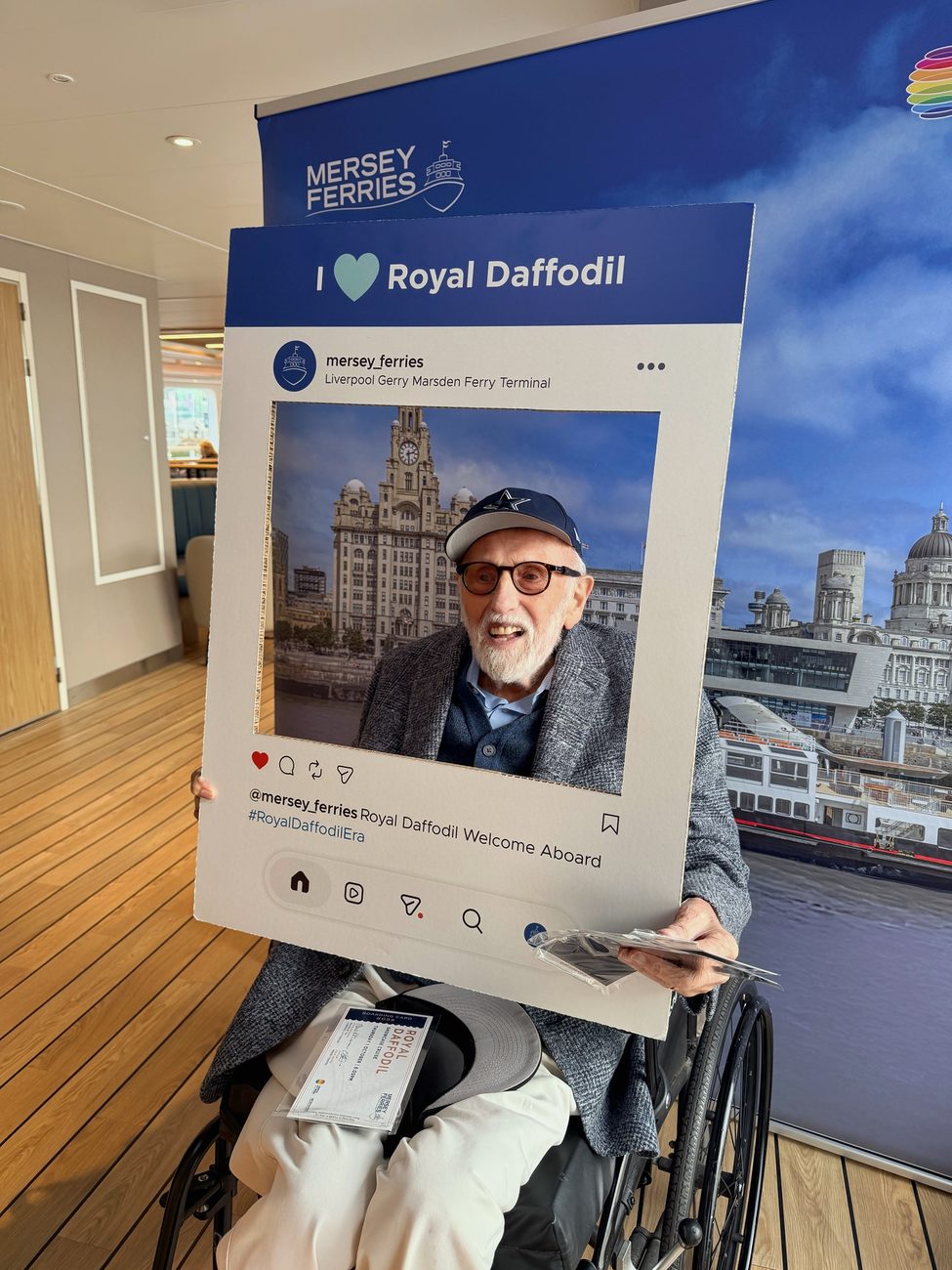
Tap the numbers to look closer.
Log 0714:00MV Royal Iris18 March 1986
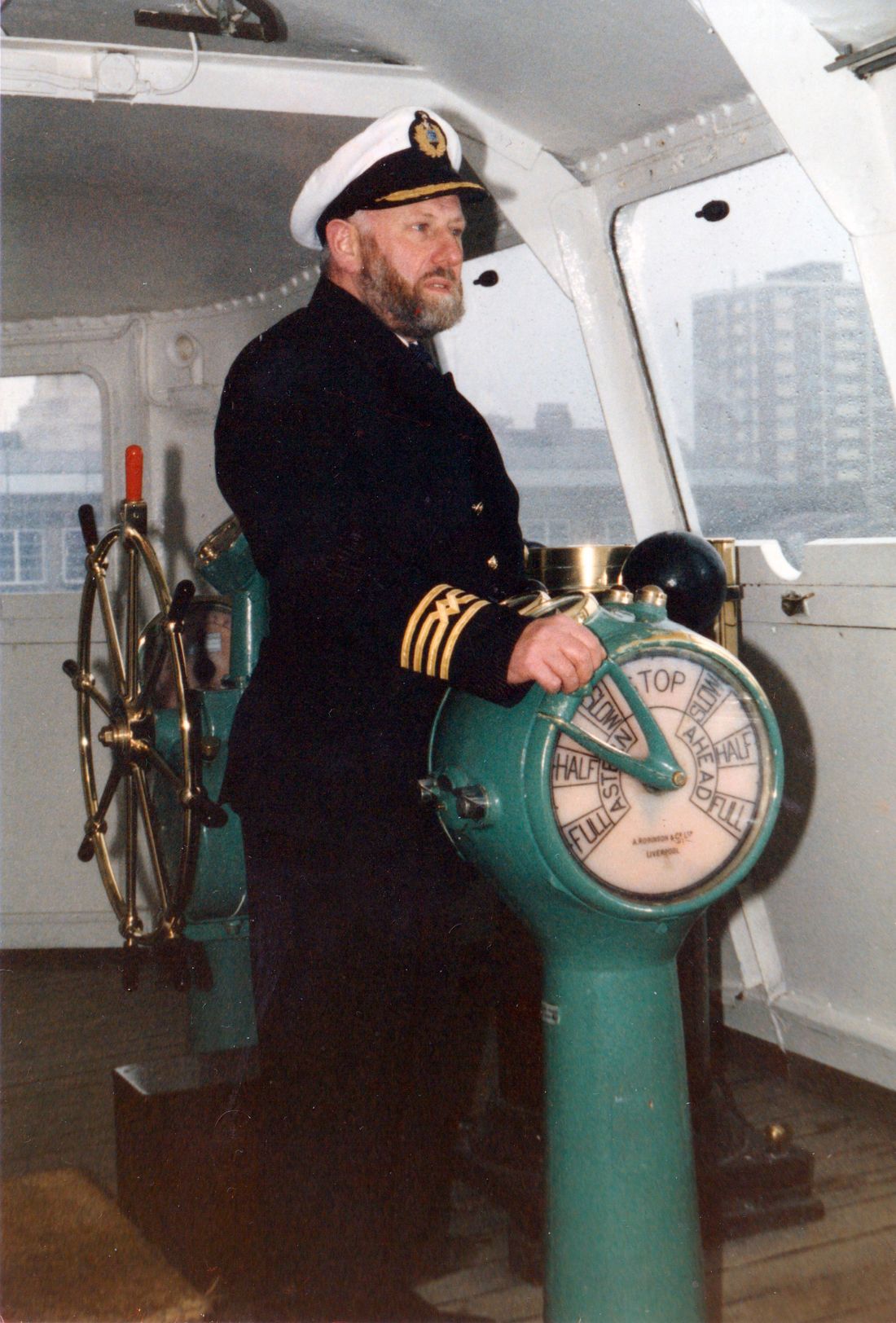
The photograph that became the mural. Captain Mike Lowe at the telegraph of the MV Royal Iris, dated 18 March 1986. Courtesy of the Lowe family.
I was in charge of the vessel completely. That was my responsibility.
Mike Lowe
A full crew was a captain, a mate, three deckhands, a chief engineer and a second engineer, on a 152-foot ship. "Mind you," Mike says, "it took a thousand."
Once the police came aboard for his second engineer. Mike told them they couldn't take him off the boat. He was part of the crew, and they would have to wait until he had finished his duty. The policeman waited.
The girls on the ferries had a name for him: Captain Birdseye, after the bearded captain on the fish finger adverts.
Log 0815:00Engine room, MV Royal IrisDiesel-electric
Ring an order in the wheelhouse and it arrives down here. The Royal Iris came from William Denny and Brothers at Dumbarton and went into service on the Mersey on 5 May 1951. Under her dance floor she was nothing like the steamers Mike started on.
She was diesel-electric. Four Ruston and Hornsby six-cylinder engines drove four generators. The generators fed two Metropolitan-Vickers electric motors, and the motors turned two shafts and two controllable pitch propellers. Twin rudders made her handy alongside. She was licensed to carry 2,296 passengers on ferry work.
Even her funnel was for show. The one by the bridge was a dummy. The real exhausts went up two stacks amidships, one on each side.
In those days, on the steamboats, the engineer gave the engines. You just sent a telegraph down, a signal, to tell him what you want.
Mike Lowe
A full crew carried a chief engineer and a second engineer. The captain rang the order. Down here, they answered it.
Your browser can't draw the engine room in 3D here, so the parts are listed in the last card below.
Down the ladder. Under the saloons, this is where the Royal Iris made her power. Four diesel engines in two pairs, each with its own generator. Ring an order on the telegraph in the picture and watch what happens.
Power. Each engine turns a generator rated at 300 kilowatts and 300 volts DC. The current runs to the switchboard and on to two Metropolitan-Vickers motors of 730 shaft horsepower, one on each shaft. The engines never touch the propellers. They make electricity, and the motors do the turning.
Twist, don't turn. Ring astern and watch the propellers. The shafts keep turning the same way. The blades twist through zero and push the water the other way. That is what a controllable pitch propeller does.
One of four. Closer in, with the casing cut away. Six cylinders in a row, each firing once for every two turns of the crankshaft. Air in, squeeze it, fuel, bang, and out with the exhaust.
In pieces. Keep scrolling and we take her apart. Heads off, pistons out, crankshaft down, and the generator drawn off the end.
The parts. One of the four generator sets, taken apart. Tap a number on the drawing, or step through them here.
1Rocker covers
A diagram drawn for this story, not a plan of her engine room. Machinery details from the Liverpool Maritime Society, "MV Royal Iris", and Wikipedia, "MV Royal Iris".
Log 0916:00Mid-riverWind rising
You never know what the river will do. One afternoon Mike went on duty in weather like any other day.
By five o'clock it was howling. Two ferries passing close to each other lost sight of one another in the spray.
She was grandma's knitting. Over one, under one.
Mike Lowe
By six it was back to normal.
Years later, after the ferries, he skippered a 76-foot former Norwegian fishing boat, done up for weekend trips to the Isle of Man. Coming home one Sunday night, it blew up out of the blue. There was no shelter back at the island, so they carried on.
But we made it. Still here.
Mike Lowe
Log 1016:40Off WoodsideVisibility poor
The fog sits thickest just south of Woodside, off Cammell Laird, Mike says, where the water runs deepest. At first there was no radar at all. Then came a radar on shore, with one of the skippers watching the screen and talking four ferries across at once. "It's a bit much, really."
One day in thick fog a ferry ran into one, broadside. Mike was on deck.
It just ploughed into him. They didn't see him, and he wasn't told.
Mike Lowe
Log 1117:20Liverpool landing stageRush hour
It's hard now to picture how full the river was. Tugs and more tugs. Barges. Ships. Dozens of little coasters, all moving at once, and a ferry crossing every ten minutes through the middle of them. Look at the river behind this page.
You got used to it those days. I think it's very sad.
Mike Lowe, on the empty river now
People went into the water more often than you'd think. One day at the south end of the Liverpool stage, Mike saw a man jump from the fire brigade's boat moored there. He tied a line round himself and went in after him.
I flew down and put a line around myself and went in, and we got him up.
Mike Lowe
Another time he went out in a boat and got a man out. Both rescues earned him an award from the Merseyside Passenger Transport Executive. Mike can’t swim.
Log 1218:00Approaching the stageSteam
On the old steamers the captain didn't touch the engines. He rang his order on the telegraph, and the engineer below answered it on his own dial. Usually.
I brought her up. Stop. Full astern. And I got full ahead.
Mike Lowe
There was a Wallasey boat ahead of him. Its captain saw what was happening and kept his own boat off the stage, and Mike went through the gap without touching either of them. Then he rang down twice for full astern.
BridgeSTOP
Engine roomSTOP
Speed0.0 kn
To the stage180 m
After the steamers came bridge control, with the engines answering straight to the wheelhouse. "You knew where you were," Mike says.
Log 1318:40On the stagePassengers
Close on thirty years on the river means a great many passengers. A few of them stayed with him. Turn a ticket over to read it, and hear Mike tell it.
She was filming on the Liverpool stage and wandered off. They found her further down, sitting with a crowd of pensioners, yapping away. "She was lovely."
Mike’s voice: Daffodil & Natural Selection Design
Mike got to know Gerry quite well. One night Gerry told him his whole life story, "after a few pints."
Mike’s voice: Daffodil & Natural Selection Design
They filmed for the BBC aboard, Mike remembers, and signed a postcard for each of the crew. He gave his to his sister-in-law. Not his cup of tea, he says. His brother was at art college with John.
Mike’s voice: Daffodil & Natural Selection Design
Mike's favourite. "I had him in the wheelhouse for an hour and a half."
Mike’s voice: Daffodil & Natural Selection Design
Married in London, they came home for a cruise and asked the captain to marry them again. "I wasn't breaking any laws." He got the book out.
Mike’s voice: Daffodil & Natural Selection Design
Mike took the Royal Iris down to London to sell Liverpool. Beer at Liverpool prices, queues at eight in the morning. A pub at Land's End cheered them round.
Mike’s voice: Daffodil & Natural Selection Design
Paul McCartney and Wings kept him company on the bridge of the Royal Iris, Mike told the Echo.
The Queen sailed on the Royal Iris on her Jubilee Year visit to Liverpool, in 1977. Mike counts her among the people he was delighted to meet on the river.
When the ferries were used for filming Chariots of Fire, Mike was the shore captain. He had the producer, David Puttnam, round to his house for dinner more than once.
While the mural went up, people told us how they bought a one-way ticket and hid in the toilets for the ride back. When we asked Mike, of course the captains knew. They let the kids have the sea air, because they knew what it leads to.
Log 1419:20New Brighton1834 to 2026
Mike's Sunday circle always took in the New Brighton boat, up the river to the pier. For well over a century the ferry brought the crowds. Scroll on and watch the pier come and go.
1834
1834. A wooden landing pier, 135 feet long, opens beside the hotel. At low tide it is useless. Passengers wade ashore, or are rowed in.
7 September 1867. Eugenius Birch's iron pier opens. At the end, a floating landing stage rides up and down with the tide. A month later a steamer in a gale smashes the bridge and sends the stage into the river. They get it back.
17 May 1918. Iris and Daffodil come home from Zeebrugge and anchor off the pier, to a heroes' welcome.
1920s. The landing stage is a stage in every sense. Divers work the crowds off the boats. "Don't forget the diver." In 1928 Wallasey Corporation buys the pier and rebuilds it. Meet Peggy Gadsby, the one-legged diver.
26 September 1971. The last ferry leaves New Brighton. Fewer people are making the trip, and the sandbanks off the stage have moved since the new docks went in at Seaforth.
1972 to 1978. The pier closes for good in November 1972. It is demolished between February and July 1978.
2026. A promenade, a lighthouse, a fort, and a question.
Log 1519:50Off New BrightonSpring tide
In September 2026 the Liverpool City Region Metro Mayor, Steve Rotheram, was aboard the new Royal Daffodil for her naming. Afterwards he told BBC Radio Merseyside that the Combined Authority is looking at whether new ferry terminals could be built, New Brighton among them.
This is one I'd love to do. The very first interview I did when I became Metro Mayor, they said what's your favourite place in the Liverpool City Region, and it's New Brighton.
Steve Rotheram, BBC Radio Merseyside, September 2026
He was straight about the problem. A landing stage at New Brighton has to cope with one of the biggest tides in Britain.
The river has nearly an 11 metre differential between high and low tides. You have to have something that floats, a pontoon. It has to be fixed to the riverbed, so there's huge engineering and costs to it.
Steve Rotheram
Would I like to do it? Yeah. Will we be able to do it? We're having a look.
Steve Rotheram
There is no funded terminal yet and no published business case. But the Metro Mayor is having a look, and he says he would love to do it. His own memory of the crossing is Mike's: the bus into town as a kid in the summer holidays, the ferry over the water, New Brighton on the other side.
Mike knows what it takes to keep a ferry. When the service was threatened years ago, he campaigned to save it with his pal Ted and a few others. He still holds that the crossing is a royal highway, and that the crowns on the gangways prove it.
So they can't shut it. It's got to go through Parliament to shut that.
Mike Lowe
Log 1620:10Off SeacombeYour watch
The last ferry left New Brighton on 26 September 1971, and the pier came down in 1978. Since then there has been nowhere at New Brighton for a ferry to come alongside.
So tonight the boat is yours. Cast off from the Pier Head, keep clear of the big ships in the channel, mind the sands along the Wirral shore, and bring her alongside where the old landing stage used to float.
Watch the tide. It runs hardest down the middle of the river, and it will carry you sideways if you let it.
Your watch · Pier Head to New Brighton
Wheel: drag it, or the left and right arrow keys. Telegraph: tap an order, or the up and down arrow keys.
Rudder0°
Speed0.0 kn
Heading338°
To the stage4.9 km
Nearest bank20 m
Engine roomStop
River clock00:00
Log 1720:30The Master Mariner, Union TerraceBerthed
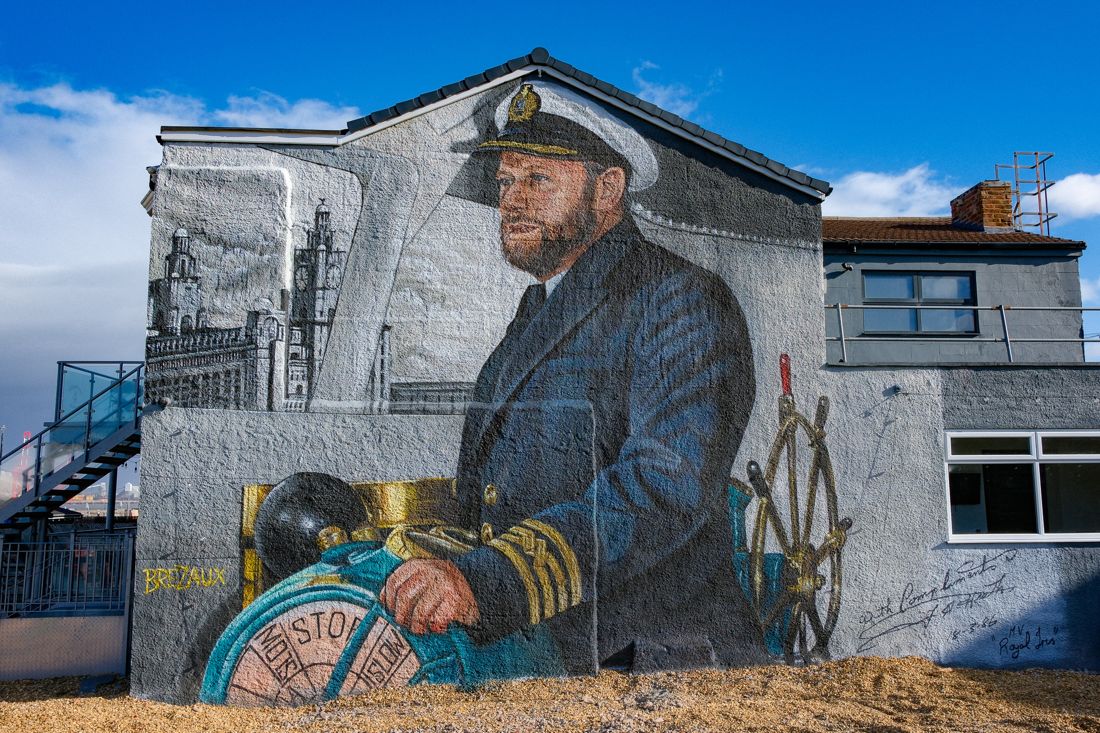
Brezaux, 2025 · The Master Mariner, Union Terrace, New Brighton · Drone footage from our mural film; photograph by Rory Wilmer
It started with one question at a meeting of the New Brighton Partnership. Pauline from the Floral Pavilion asked: what about a mural for Captain Mike Lowe?
We wanted to say thank you while Mike could see it, enjoy it, and feel what the town thinks of him. With his son Jonny and the Lowe family we went through the photo archive and chose the picture from the Royal Iris. Adam Bresnen, who paints as Brezaux, started on the gable end of the Master Mariner with a doodle grid of letters and numbers. People stopped to watch it come through, layer by layer. Five days later Captain Mike was looking out across the river.
The print, 1986Courtesy of the Lowe family
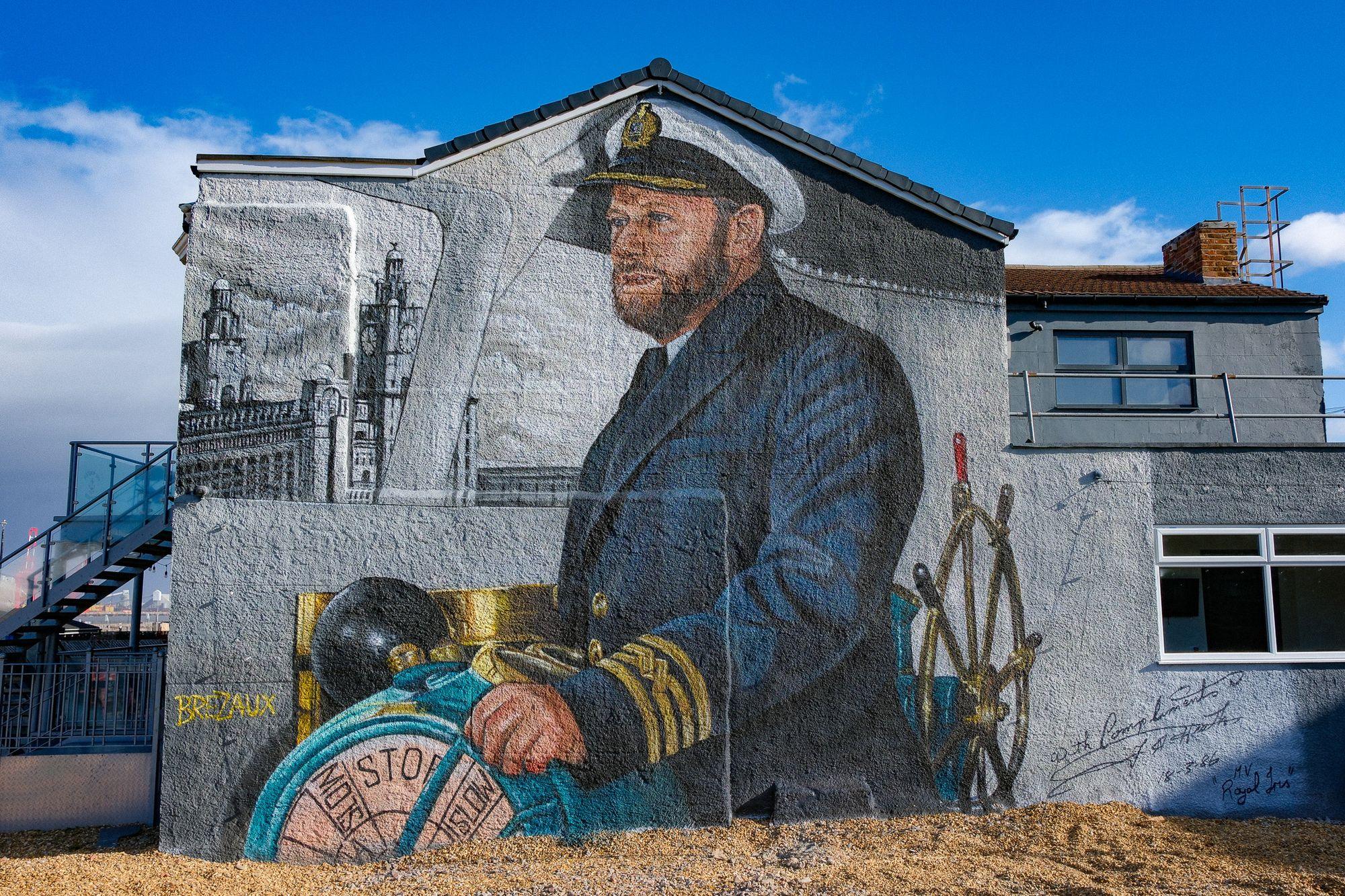 The wall, 2025Photograph by Rory Wilmer
It was New Brighton Creative Futures' first commission and the first portrait in our Local Heroes series, part-funded through the UK Shared Prosperity Fund, with APCL Cammell Laird as our main sponsor. The Guide Liverpool, The Floating Grace and people from all over the town helped pay for it.
We kept the wall from Mike for as long as we could. His son told him five days before the unveiling.
He was completely overwhelmed. It is also important for dad to stress that it’s not just for him but also to celebrate all the people who have worked tirelessly on or around the river over the many years.
Jonny Lowe, Mike’s son, in My Planet Liverpool
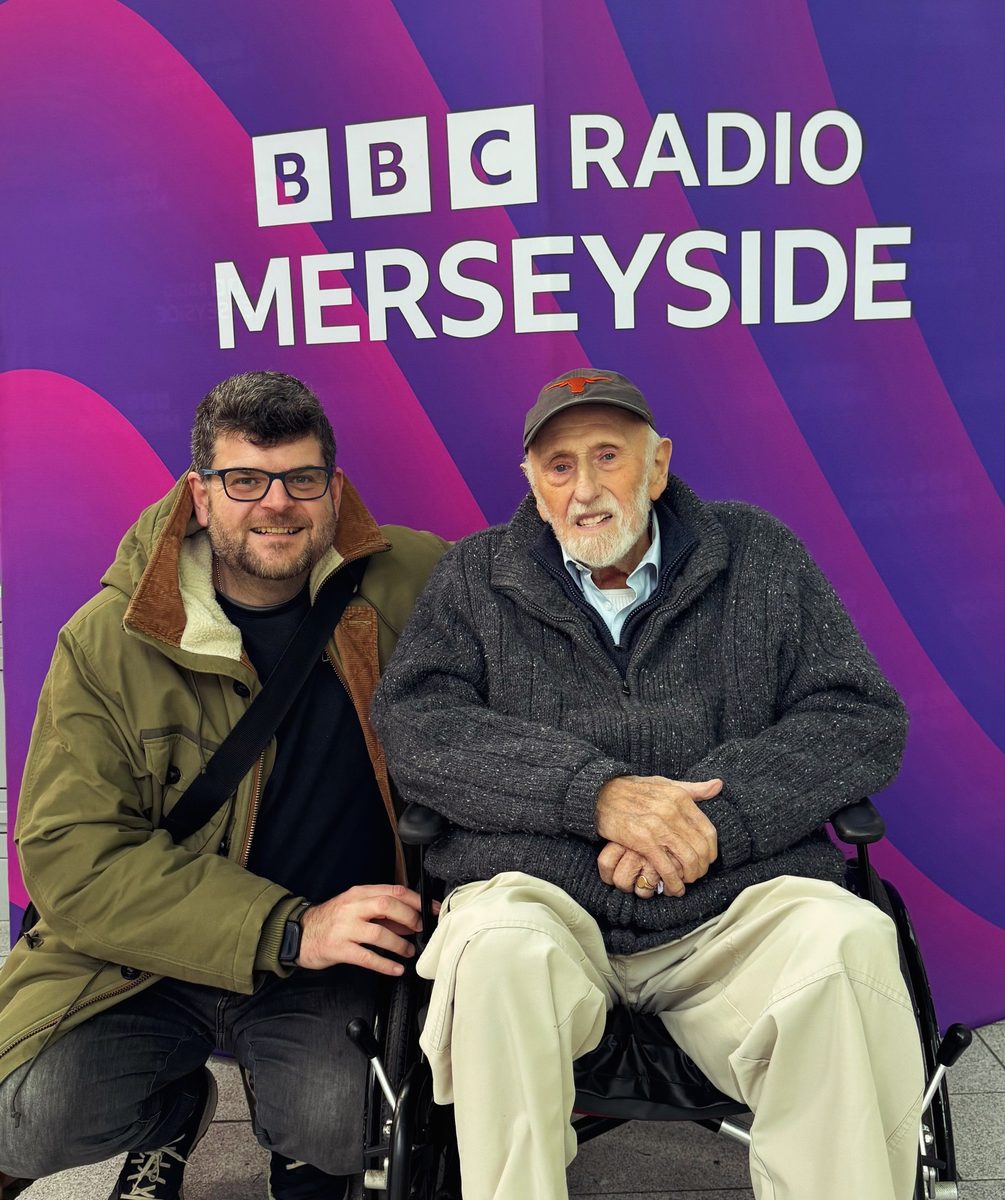
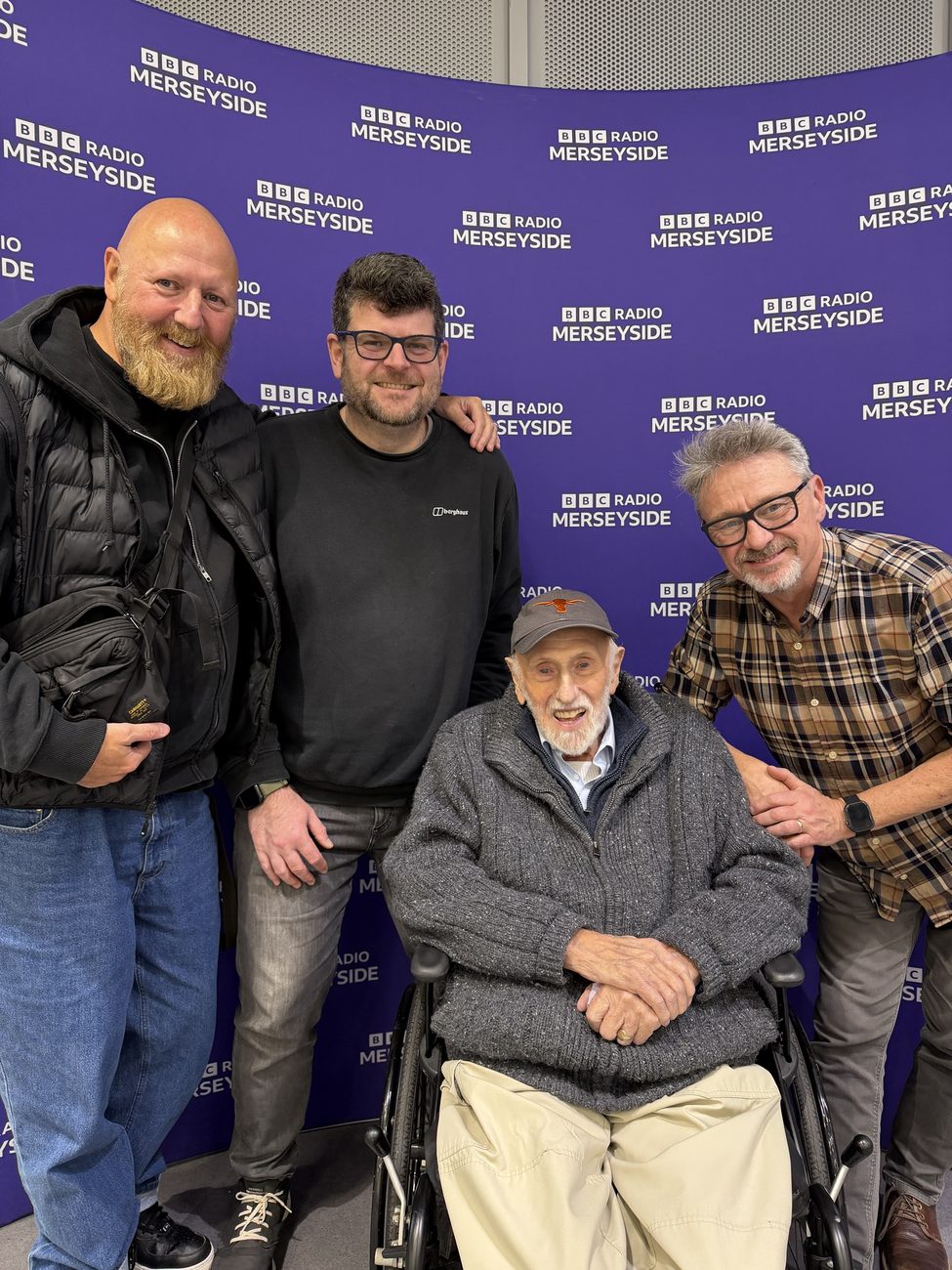
On 14 November 2025 we unveiled it properly. Mike, then 92, came with the Lowe family. So did the Mayor of Wirral, Councillor Brian Kenny, the council leader, Councillor Paula Basnett, and Dame Angela Eagle MP, with people from Cammell Laird, Wirral Council and the Liverpool City Region Combined Authority, and a packed Master Mariner. Together they unveiled a plaque with a QR code that brings you to his story. You may be reading this because you scanned it.
We called the wall a bridge between generations, and that night it felt like one. Read about the night.
The River Mersey has been such a big part of Dad's life. Seeing him recognised in this way has brought him so much happiness and pride.
Jonny Lowe, Mike's son
Unveiling photographs by Pete Carr. Mike at the wall by Rory Wilmer. Tap to enlarge.
Since the wall went up
Log 1820:40The Master MarinerThe colour swatch
This is the colour swatch for the mural: forty-eight colours, in eight rows of six. Look at the wall for long enough and they sort themselves into six families, each with its own job. Pick a family, or a single colour, and we will show you where it lands.
The wall in daylight
Photograph by Rory Wilmer
All forty-eight
Every colour on the card, eight rows of six. Tap one to find it on the wall.
We match each colour against a photograph, so sunlight, shadow and weather shift things a little. Treat it as a guide, not a paint chart.
Log 1920:50The film3 min 6 s
Rory wrote and produced a song for Mike. Here it is with our film of the wall going up, the river he worked, and the archive footage of the ferries in their prime.
Music: The Ballad of Captain Lowe, written and produced by Rory Wilmer. Film by Rory Wilmer for New Brighton Creative Futures, including archive footage of the Mersey ferries, with thanks to APCL Cammell Laird, The Guide Liverpool and the Master Mariner. Also on YouTube.
Log 2021:00New BrightonFinished with engines
It was a good life. I've had no regrets at all. None whatsoever.
Mike Lowe
Every tide carries a story. Our river remembers those who guide us across it.
The Master Mariner Bar & Grill
3–5 Union Terrace, Marine Promenade
New Brighton, Wallasey CH45 2JT
Crossed on the New Brighton boat, worked the ferries, or have a photograph of Mike at the wheel? We would love to see it.
info@hellonewbrighton.com
Everything given to New Brighton Creative Futures goes into art and artists, and into looking after the walls we already have.
Every clip of Mike’s voice on this page, and the words that follow along with it, comes from the interview video made by Daffodil and Natural Selection Design. They kindly gave us permission to use it, and we are very grateful. Daffodil is the old Overchurch from Log 05, now a bar and restaurant in Canning Dock.